
How Substitute Teachers Actually Get Booked in Ireland

- Two in three substitute teachers (64%) get work straight from a school that already knows them and picks up the phone. It runs on relationships and word of mouth.
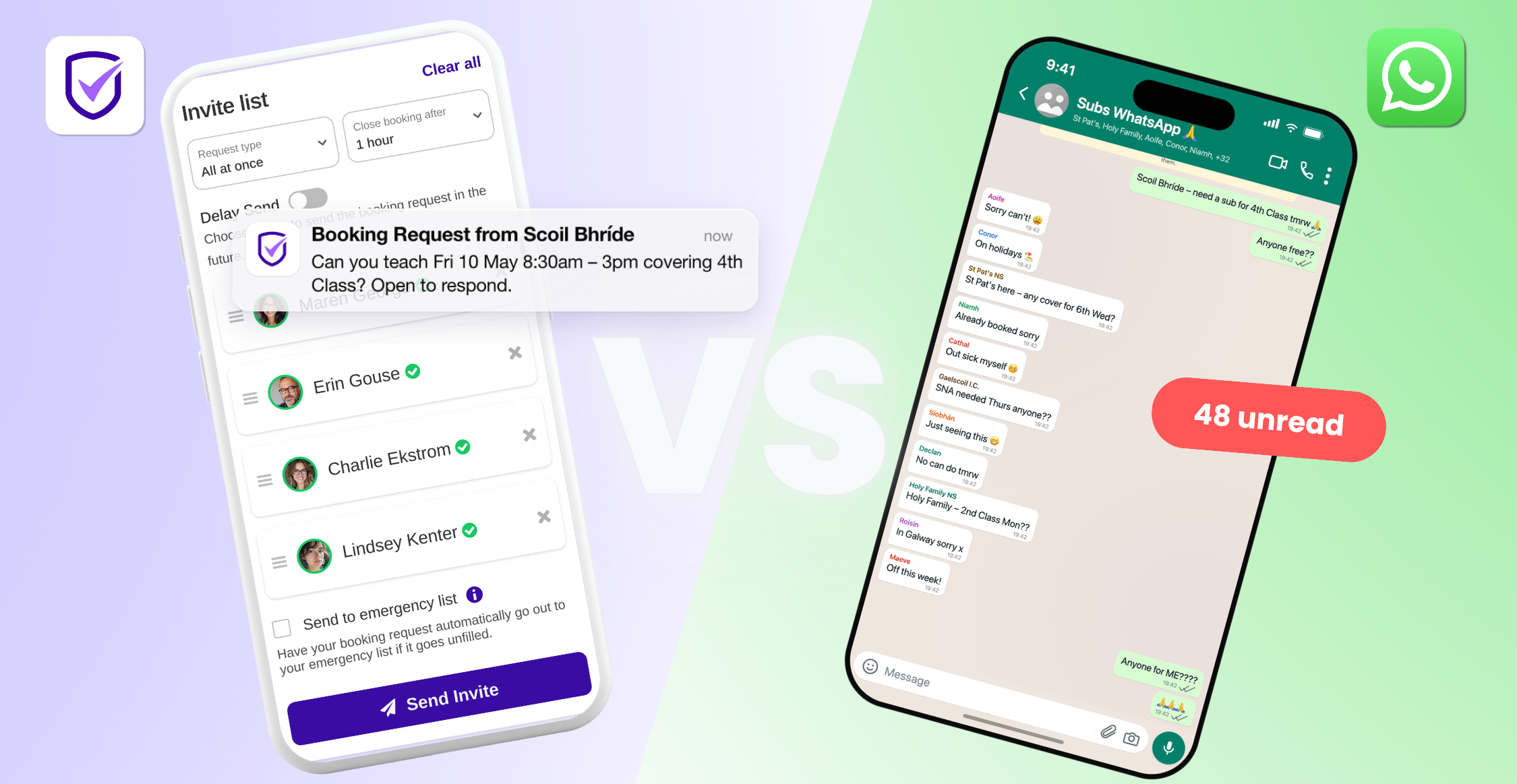
- Half of substitute teachers (49%) rely on WhatsApp groups, and the main cover groups are already full, locking out new subs and leaving schools posting to a crowd where many no longer sub.
- SNAs are the most exposed of all: one real channel, nothing built for them, and per-school Garda vetting that keeps them off the tools subs use.
The short answer: We surveyed over 1,000 substitute teachers and SNAs across Ireland asking one question: how are you currently getting booked for work? For substitute teachers, the answer in 2026 is strikingly low-tech. Two in three get their work from a school that already knows them and picks up the phone. Half live in WhatsApp groups. And a good share of NQTs and teachers new to subbing are finding it hard to get a look in at all. Ireland is short of substitute teachers, and the scattered, informal way cover gets found is making that worse. A booking platform like ClassCover is what joins it back up.
What we asked, and who answered
As ClassCover prepares to launch in Ireland, we wanted to know how substitute teachers currently get their work, so we asked them directly. More than 1,000 substitute teachers and SNAs from every county replied, ticking all the channels that apply, which is why the figures below add up to well over 100%.
These are people actively working right now. Geographically they cluster where the population does: Dublin at 21%, Cork at 11%, Galway at 8%, with Tipperary and Limerick close behind.
The mix at a glance
| Channel | Substitute teachers |
|---|---|
| Direct phone or text from schools they know | 64% |
| WhatsApp groups | 49% |
| Sub Seeker | 27% |
| Other (free text) | 11% |
| Facebook groups | 6% |
| Recruitment agency | 2% |
Source: ClassCover
Substitute teachers run on relationships
Strip it all back and the biggest channel is also the oldest. A school that already knows you picks up the phone and asks if you are free. Nearly two-thirds of substitute teachers (64%) get their work exactly this way. No mechanism to let the school know real-time availability, just a number saved in a principal's phone and a bit of trust built up over the years.
Most of the time it holds together well enough. It falls apart on one specific morning: the one where your regular subs are unavailable. That is when the phone tree starts, and a principal's morning vanishes into it. One principal we interviewed had a formal supply panel to fall back on, but it held just seven teachers shared across seventeen schools, so on the mornings he needed someone it was almost always tapped out.
Finding cover here already runs on trust. The people are real and the relationships are real. What's missing is the layer that keeps it working when your first three calls come back with a no.
None of that trust goes to waste on ClassCover, a booking platform for substitute teachers and SNAs now rolling out in Ireland. It keeps the subs a school leans on right at the top of the list and makes them easier to reach, while connecting schools to a wider pool nearby: availability in one place, a booking confirmed in a tap, no ringing round. When your regulars are all busy, it widens the net to other trusted subs nearby.
WhatsApp is a close second
The second biggest channel for substitute teachers, by a distance, is WhatsApp. Half (49%) find work through it, and it is easy to see the appeal. A message appears in a stream of messages, you reply, you are booked, if you happen to get there first. Fast, mobile, no faff.
The trouble is everything WhatsApp cannot do. It keeps no availability list, no record of who said yes first, no confirmation that the booking happened. And it buckles at scale. WhatsApp caps a group at 1,024 members, and in cities like Dublin the main cover groups are already full. That does damage: the ready, willing subs who could be filling classrooms cannot get in, and a school posting to the group will never see them. A full group is not a live one either, padded with members who stopped subbing long ago, so a cover request lands in front of a crowd where many are no longer looking. One principal we interviewed described firing a request into a group of close to 500 and getting 20 replies in a minute from people he could not check: as he put it, "you tend not to know any of them, so you can't verify them."
Add in the personal phone numbers exposed to a thousand-odd strangers and the open invite links that let anyone in, and it becomes a safeguarding problem. Impersonation and scam activity on WhatsApp is a known and rising threat in Ireland, flagged by the National Cyber Security Centre (RTÉ), and an open group holding hundreds of principals' and teachers' contact details is exactly the kind of soft target those warnings describe.
Subs put up with all of it because nothing better exists. We take the full case apart in our piece on why WhatsApp groups can't solve Ireland's substitute teacher crisis.
How much cover rides on a single channel
Averages hide the telling part: how exposed a sub is when their main channel goes quiet.
| How they source work | Substitute teachers |
|---|---|
| Use one channel only | 55% |
| Juggle two or more channels | 45% |
| Rely solely on direct school contact | 24% |
Source: ClassCover
Nearly half of substitute teachers work two or more channels, so if one dries up there is another still running. But more than half have a single way in, and a quarter rely on nothing but a direct call from a school that already knows them. For them, a quiet phone is the whole picture.
How it varies by county
There is no national way substitute teachers get booked in Ireland. There are local habits, and they differ more than you would expect. The channel a sub leans on depends a lot on where they teach.
The clearest split is between Dublin and everywhere else. Across the Dublin commuter belt, taking in Kildare, Meath and Wicklow, 57% of substitute teachers get work through a school that already knows them, against 68% in the rest of the country. WhatsApp is lower too: 45% across the commuter belt against 51% elsewhere.
That runs against what you would expect from the biggest population centre. Dublin has the most schools and the most subs, and the personal networks that carry cover everywhere else are thinner there. The biggest pool of people is the hardest place to be known.
Results for substitute teachers by top 10 counties
| County | Direct contact | |
|---|---|---|
| Dublin | 56% | 43% |
| Cork | 60% | 48% |
| Galway | 65% | 47% |
| Tipperary | 57% | 77% |
| Limerick | 71% | 54% |
| Kildare | 47% | 53% |
| Mayo | 76% | 48% |
| Meath | 59% | 50% |
| Wexford | 73% | 41% |
| Kerry | 70% | 55% |
Source: ClassCover
Tipperary leans on WhatsApp harder than anywhere: 77% of subs there get work through a group, against 49% nationally. It is one of only two counties, with Kildare, where WhatsApp edges ahead of a direct call. Everywhere else the phone still comes first, though how far ahead varies a lot from place to place.
The upshot is a different experience of the same job depending on which side of a county line you are on. A sub who moves county often starts building a reputation from scratch, and the way a school finds cover is only as good as the habit its area happens to have landed on.
The supply pool schools never see
There's an added challenge here for anyone new to subbing: a newly qualified teacher, someone back from a few years abroad, or a teacher taking it up as a semi-retirement. They are qualified and ready to work, but they start with none of the relationships it all runs on.
With cover sorted through personal contacts and WhatsApp groups that are often already full, there's no simple way for them to get found. For a lot of them the route in is still to pound the pavement, calling into schools in person to drop off a CV. A capable sub can be a few streets from a school that needs them and still not be on its list.
Ireland is short of substitute teachers, no question, and the wider shortage is well documented. But part of the answer is already here. New and returning teachers come into subbing all the time. The catch is that the usual ways of finding cover only pick them up once they are already known. A way to surface them sooner would put more of them in front of schools when it counts.
The supply pool is bigger than any one phone list. Every school has available subs near it right now that it has no way to see. Close that gap and cover gets easier without adding a single new teacher to the system.
Why the pattern points to a booking platform
Line the channels up and the weak ones all share a flaw: they leave the sub waiting. You post to a job board, message a group, drop a CV at the office, and then everyone sits back to see what comes back. Nothing is settled.
That is why, for all the newer options, most cover still gets sorted the old way, with a call to a school that already knows you. The phone survives because it reliably ends in a yes, and a yes is the whole point. A jobs board waits; a booking platform confirms.
ClassCover gives that certainty to everyone, not just the subs lucky enough to sit in a principal's phone. A school builds a shortlist of subs it trusts and books them first, with an automatic fallback to a wider local pool when they are busy. Subs set their availability once and get booked in a tap, including the ones who were never on anybody's list. Schools get cover in minutes, subs get booked with a tap.
Where this leaves SNAs
Ireland funds close to 24,900 SNA posts, a workforce that has grown every year. For a role that size, the way SNAs actually get booked is astonishingly thin. Substitute teachers at least have a spread of channels; SNAs have one. Almost all get booked the direct way, by phone and text from a school that already knows them: 65% get work that way, 42% have no other route at all, and nearly three-quarters (73%) rely on a single channel. It is the most exposed position of anyone in the survey.
They cannot be booked the way subs are through a WhatsApp group, and the reason is Garda vetting. Every SNA is vetted individually by each school that takes them on, a process one principal we interviewed put at a minimum of three weeks, form by form. A school cannot pull an unknown SNA out of a group chat and book them for the morning, because the vetting has to come first. Sub Seeker, the one dedicated booking tool, is open only to Teaching Council-registered teachers, so SNAs are shut out of that too. The nearest thing they have is the EducationPosts.ie job board, used by 16%, and even that is a place to find schools to connect with rather than a way to get booked.
ClassCover does not carry out the vetting: the school stays responsible for that, exactly as now. What changes is that an SNA can be found. They set up a profile once, schools nearby can add them to their lists, and once a school has vetted them they get booked the same way a substitute teacher does, with a request that only reaches them when they have marked themselves free to work. Being on several schools' lists at once turns one fragile channel into many, so an SNA is no longer waiting on a single phone to ring.
What this means for principals
Your best cover is the sub you already know, and the data is firmly on your side. The relationship was never the problem. What breaks is the morning it comes back empty, with your regular booked and the trusted names all out.
That is the moment ClassCover is built for. It keeps your own subs first in line and stretches your reach past them, into the vetted, available people near your school you currently have no way of finding. The 39-call morning is what happens when the tool is missing.
What this means for substitute teachers
Getting found is the hard part, especially when you are new. ClassCover changes how that works. You set up a profile and your availability once, schools in your area can find you, and you can ask to join their lists. Instead of dropping CVs into front offices, you become discoverable to the schools around you, and the more lists you are on, the more cover requests reach you.
You still have to be on a school's list to be booked, but once you are, requests come straight to you when it needs someone, with no re-registering every week to stay visible. If you are just getting going, our guide to what substitute teaching in Ireland really looks like walks you through it.
The model is already proven
None of this is theoretical. ClassCover runs exactly this model in Australia, where 1 in 2 schools use it to book substitute teachers and SNAs, and most cover is confirmed in under three minutes. The average booking lands in 2 minutes and 17 seconds.
The subs were always there. What changed was the layer connecting them to the schools that needed them. Ireland just has not had that layer until now.
Coming to Ireland
Cover today runs on trust and lives in scattered, informal channels, and it leaves a lot of willing, capable people on the outside looking in. That is a fixable problem, and it is the one ClassCover is built to fix.
ClassCover Ireland is live now at classcoverapp.ie, and it is the first platform to book SNAs alongside teachers. Schools can apply for the pilot. Substitute teachers and SNAs can download the app, and for them it is free, always.
Don't post and wait. Book and be done.
For schools
ClassCover Lite is free for every school in Ireland. Schools in the nine pilot counties also get ClassCover Standard free until 1 December 2026.
For subs & SNAs
The ClassCover app is now live in Ireland. Download it free, set up your profile and availability, and local schools can book you as they come on board.
ClassCover is free for substitute teachers and SNAs. Always.
Further reading
For broader Irish education and regulatory context: Department of Education and Youth (gov.ie), Teaching Council of Ireland, Irish National Teachers' Organisation, Teachers' Union of Ireland, National Vetting Bureau (Garda vetting).
Frequently Asked Questions
Most get booked directly. In a survey of more than 1,000 substitute teachers and SNAs across Ireland, 64% of substitute teachers said they get work through phone calls and texts from schools they already have a relationship with. WhatsApp groups (49%) and Sub Seeker (27%) follow. The whole thing is relationship-led and largely informal.
Yes, widely. 49% of substitute teachers said they get booked through WhatsApp groups, making it the second most common channel. WhatsApp is fast and mobile but unstructured: messages get missed, there is no availability list, and nothing confirms the booking. In the cities the main cover groups are also full, so new subs cannot get in.
There is no shared place for available subs and the schools that need them to find each other. Cover gets sorted through personal contacts and WhatsApp groups, none of which show who is free or confirm a booking, so a school rings round while available subs nearby never hear about the job.
Almost entirely through a school that already knows them, by phone and text: 65% get work that way and 42% have no other route. SNAs cannot use Sub Seeker, which is open only to Teaching Council-registered teachers, and per-school Garda vetting means a school cannot simply book an SNA it has not already vetted. The nearest thing to a dedicated channel is the EducationPosts.ie job board, where SNAs find schools to connect with rather than get booked.