
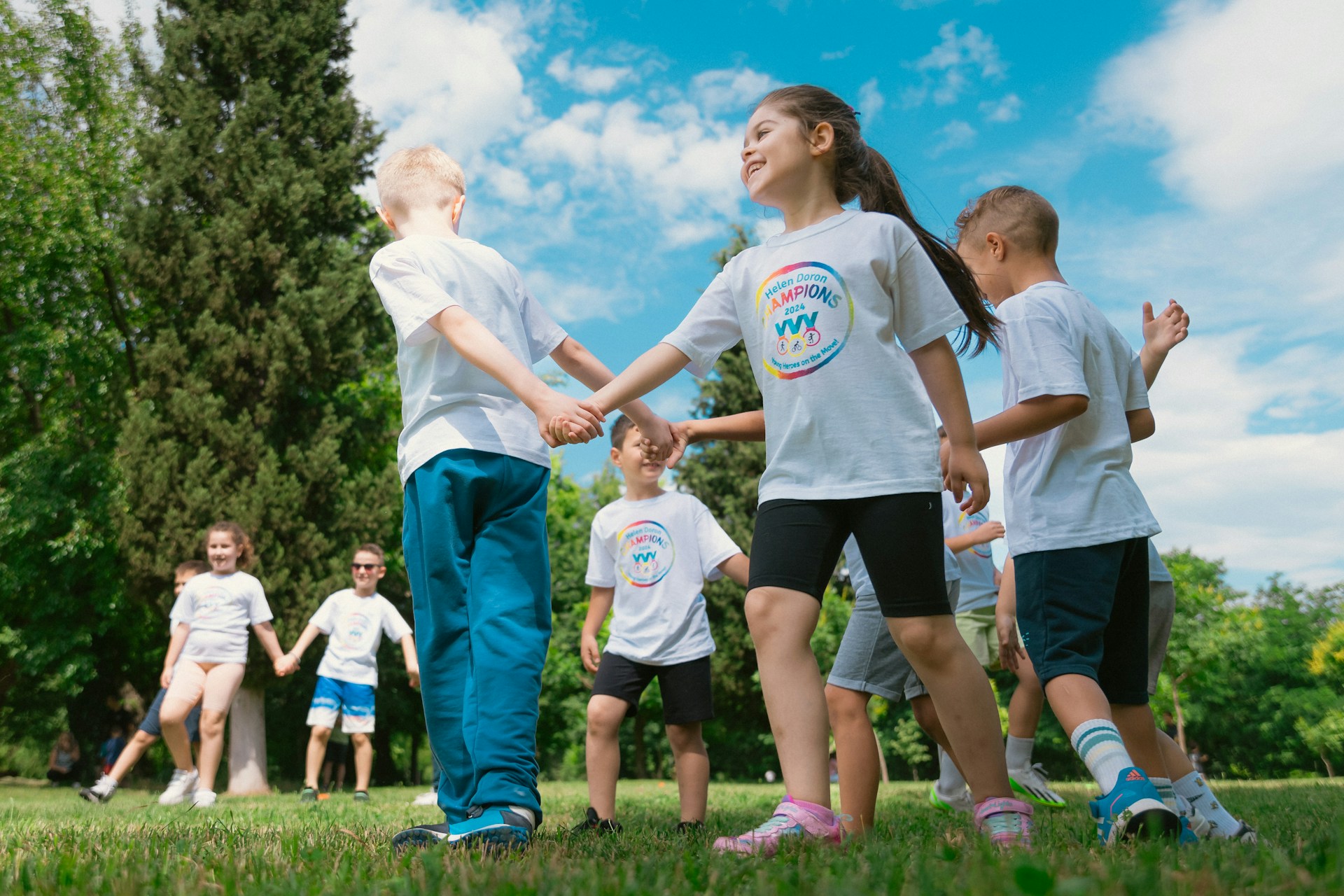
No plan, no panic: Easy PE games for Irish primary subs

- Most great primary PE lessons run on cones, voice, and the children's own enthusiasm. You do not need a hall full of gear.
- Thirteen no-equipment and small-kit games will fill any PE slot from Junior Infants through Sixth Class, plus a Gaelic football warm-up.
- Tag each game to one of the six PE strands so the regular teacher sees you taught the curriculum, not just kept the class busy.
It's 7.42am. The phone goes. A school in Cork has a sub booking and needs you in by half nine. You say yes. You're halfway down the stairs before you realise: you have just signed up to teach somebody else's PE class.
No plan in the folder. No idea where the hall is. Forty-five minutes between the line the gear is in the press, you'll be grand and the children walking in.
You like sport. You played a bit at school. You have a few jerseys in the drawer. But you are not a PE teacher. Filling a full hour of physical activity for twenty-eight children you've never met is a different job. You are, technically, in a pickle.
Don't panic. Open the boot, grab the tote bag you keep packed for exactly this moment, and walk in. The fourteen games below are the ones I would have wanted on my phone screen the first time that morning happened to me. Every one is tied to a PE strand. Every one runs with what you already carry.
Why this works in Irish primary classrooms
Physical Education sits inside the Wellbeing curriculum area of the redeveloped Primary Curriculum Framework alongside SPHE. PE itself still runs on the six strands many of you will know already: athletics, dance, gymnastics, games, outdoor and adventure activities, and aquatics, set out in the NCCA Primary Physical Education Curriculum.
If the school is on the Active School Flag journey, that's even better news for you as a sub. Movement breaks, learning on the move and short structured activities are exactly what the school is already working toward. A well-run PE lesson on a wet Friday is the kind of thing principals notice.
The activities below have one thing in common: a child of any ability can take part. Most run in a yard or hall. Most also work indoors with a bit of furniture shuffling. Each one names the strand it sits in so you can drop the right tag into the handover note.
"PE doesn't need gear to be good. It needs a sub who knows the strands, names them in the handover note, and leaves the children buzzing for break. That is the brief."
— Ben Grozier, CEO, ClassCover
Seven no-equipment activities
1. Stand-up circles (games, athletics)
Children sit cross-legged in a circle, arms around each other's shoulders. On your signal they try to stand together without breaking contact. Start with groups of four. Build up to half the class. Then the whole class. Eight to twelve minutes.
2. Speed bounce (athletics)
Each child picks a line on the floor and jumps side-to-side, counting bounces, until you call stop. Use a thirty-second timer and run three rounds with rests. Brilliant warm-up. Five to ten minutes.
3. Ladders (games)
Pairs sit in two facing lines on the floor, legs extended toward each other to form a ladder of legs between them. Number each pair. When you call a number, that pair stands, steps carefully along the ladder to one end, runs around the outside, and returns to their place. Safe spacing matters. Ten to fifteen minutes.
4. Mirror partners (dance, gymnastics)
Children pair up, face each other, hands out but not touching. Partner A moves slowly. Partner B mirrors. Swap after one minute. Add music if the room has speakers. Eight to fifteen minutes.
5. High jump practice (athletics)
Pairs work side by side against a wall. Each child jumps and reaches as high as they can. Their partner coaches three attempts, then they swap. A wall with brick or a height marker makes the reach easier to track. Ten to fifteen minutes.
6. Standing long jump (athletics)
Pairs again. Partner A jumps from a chalk line on the yard, or a piece of masking tape on the hall floor. Partner B marks the landing spot. Partner A returns, takes one step sideways, and jumps again to beat the previous distance. Ten minutes.
7. The mouse trap (games)
Half the class join hands in a wide circle. The other half are mice who run in and out of gaps in the circle. On your call, the circle tightens and the children drop their arms. Anyone caught inside the trap is out. Swap roles after three rounds. Ten to twenty minutes.
Six games with one small piece of kit
8. Catch the stick (games)
Children stand in a circle, numbered consecutively. You stand in the centre holding a rolled-up newspaper or a foam pool noodle upright on its end. Call a number, then release the stick. The child whose number you called must reach the centre and catch the stick before it falls. Use newspaper or foam only. Never a real hurley. Ten to fifteen minutes.
9. Overpass (games)
Two teams. Team A forms a circle. Team B forms a second circle around them. Each team has one soft ball and they pass it around in the same direction. The first team to complete a full lap calls out. Variations: bounce passes, chest passes, or everyone runs once around their circle before passing. Twelve to twenty minutes.
10. Bounce change (games)
Two lines five metres apart. Each child stands beside a partner in the other line. You stand in the middle with a small hoop on each side, each containing two or three balls. Call two numbers. Those children bounce-pass their ball to the opposite hoop. The first team to land all their balls in the other hoop wins the round. Twelve minutes.
11. The oyster shell (games)
Two teams along parallel lines, three metres apart. Goal lines another five metres behind each team. You stand in the middle with a bean bag that has an X on one side and a Y on the other. Toss the bean bag. Whichever side shows, that team runs for its goal line. The other team chases. Tags count as captures. Children love this one. Fifteen minutes.
12. Treasure chase (games)
Children line up behind a line, hands cupped together. One child holds a small treasure (a stone, a piece of chalk, a coloured marker cap) and walks down the line pretending to drop it into each pair of hands. Only one actually gets it. That child sprints toward a goal line at the far end of the yard. The others give chase. If they tag the runner before the goal line, the runner is out. Otherwise the runner becomes the next treasure-holder. Twelve to fifteen minutes.
13. Invent your own game (extension)
Set pairs or groups of four a challenge. Invent a new game using one cone, one ball and a chalk line. They have ten minutes to plan, then they teach it to another group. Each group plays the other's game for five minutes. Hits the Wellbeing strand of the PCF directly because it asks children to negotiate rules, take turns and respect another group's design. Twenty to thirty minutes.
A Gaelic football warm-up
14. Solo, catch, pass (games, athletics, Gaelic football basics)
You do not need a hurley or even a sliotar for this. Use any soft ball, beach ball or foam ball that is safe for the space.
Three stations around the yard or hall. Pairs rotate through them every three minutes. The stations are based on the fundamentals taught in the GAA's Cúl Camp coaching programme, so children will recognise them.
- The solo. Hold the ball out in front, drop it onto the foot, catch it back. Try ten in a row.
- The catch. Toss the ball straight up, clap once, catch it on the way down. Add a second clap once they have one nailed.
- The pass. Stand three metres apart and hand-pass a soft ball back and forth. Twenty passes without a drop is a class record.
Curriculum strand: games, with athletics in the mix. Twelve to twenty minutes total.
The handover note for a PE day
The last five minutes matter as much as the rest of the lesson. On the regular teacher's desk, leave four lines:
- The activities you ran, in order, with the PE strand for each one.
- Any child who needed encouragement or modification, and what worked.
- One small win you noticed. A child who jumped further than they thought they could. A pair who invented a clever rule.
- Your name, your number, and your availability for the rest of the term.
Principals do not forget the sub whose PE lesson ran smoothly. Strand tags in the note tell them you taught the curriculum, not just kept the class busy.
For more on subbing in Irish primary classrooms, see our piece on what substitute teaching in Ireland really looks like.
For schools
ClassCover Lite is free for every school in Ireland. Schools in the nine pilot counties also get ClassCover Standard free until 1 December 2026.
For subs & SNAs
The ClassCover app is now live in Ireland. Download it free, set up your profile and availability, and local schools can book you as they come on board.
ClassCover is free for substitute teachers and SNAs. Always.
Further reading
For broader PE and physical activity context in Irish schools: Active School Flag (Department of Education and Department of Health), Irish Primary PE Association (IPPEA), NCCA Physical Education Curriculum, GAA Learning portal.
About ClassCover
ClassCover is a mobile booking platform built for substitute teachers and SNAs. Schools book the subs they already trust. Subs get booked with a tap. The app is live in Ireland now, and setting up your profile early means you are visible the moment your local schools start booking. Download the free app.
Frequently Asked Questions
Seven no-equipment activities work in an Irish primary classroom or yard: stand-up circles, speed bounce, ladders, mirror partners, high jump practice, standing long jump and the mouse trap. Each takes ten to twenty minutes and ties to a PE strand.
Physical Education sits inside the Wellbeing curriculum area of the redeveloped primary curriculum, alongside SPHE. PE itself still runs on the six strands set out by the NCCA: athletics, dance, gymnastics, games, outdoor and adventure activities, and aquatics.
Pick one warm-up, one main activity from the small-kit games, and a calm cool-down. Aim for ten minutes per phase, name the strand each game ties to, and finish with a sixty-second class reflection.
The Active School Flag is awarded to Irish primary and special schools that demonstrate a physically educated, physically active school community. Schools on the ASF journey value sub-led PE lessons that keep movement structured and purposeful.